
Farragut City Directories on McClung’s Shelf
Farragut is a town in Knox County, and it incorporated in 1980. Earlier residents may therefore appear under Knox County, Knoxville, Concord, Campbell Station, Kingston Pike, or another postal or community label. The historical shelf for this kind of name-and-address research is the Calvin M. McClung Historical Collection at the East Tennessee History Center. Its reference materials include Knoxville directories, telephone directories, biography files, maps, newspapers, census microfilm, and local government records.
| Collection | Years located | Where held | Access |
|---|---|---|---|
| Knoxville directory, City Directory Co. of Knoxville | 1859–60 photocopy; examples from 1869, 1889, 1891–92, 1901 onward, and later selected runs through 2025 | McClung reference collection | In-library reference use |
| Digitized Knoxville volume | 1907 and 1926 volumes located | Google Books, with library cross-check | Online viewing |
| Knoxville telephone directories | 1898 onward | McClung reference desk | Request for reference use |
| Pre-Urban Renewal occupant map | c. 1953 | Knox County Library interactive map | Online map project |
The catalog does not prove that every year in a long span is present. Its verified holdings include 1946 parts, 1948–49, 1950–51, 1962, 1964–77, 1979–2008, and 2016–2025, while the catalog notes that 2009 was not published. Treat a date gap as a research question, not proof that a household was absent.
The captured McClung Collection page identifies the local-history resources that support this Farragut directory search.
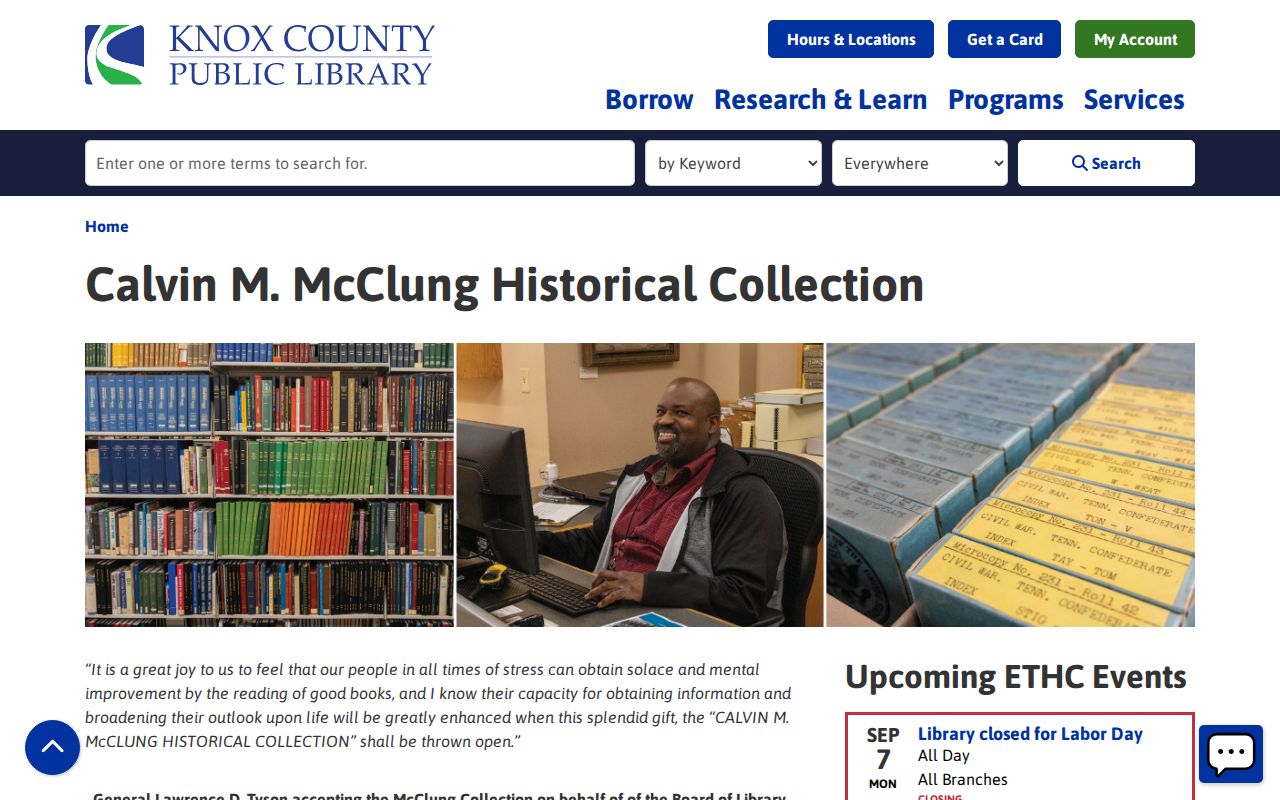
McClung’s directory, map, obituary, newspaper, and microfilm holdings make it possible to test an entry against more than one type of historical record.
Farragut Directory Years and Gaps
The Knoxville directory catalog record identifies the local publisher and gives a 1923- publication designation. It also records the McClung note for an 1859–60 photocopy. For Farragut research, the varied geographic labels matter as much as the year. A household near Kingston Pike might be indexed under a Knoxville route, a county place name, Concord, or Campbell Station instead of a modern Farragut line.
| Date | Directory context |
|---|---|
| 1859–60 | McClung catalog note for a Knoxville directory photocopy. |
| 1907 | Digitized Knoxville volume located for online comparison. |
| 1926 | Digitized volume with alphabetical and street or business material. |
| 1980 | Farragut incorporated, so earlier municipal labels need careful comparison. |
| 2009 | Catalog note says the directory was not published. |
| 2024–25 | Catalog entries are split into parts or bindery records. |
A search should collect the exact title, year, page, part, and spelling used in the volume. Keep the source label even when it differs from a modern address. That small habit prevents a directory line from being mistaken for a current parcel or a town-limit statement.
Using the Farragut Directory Room
McClung is on the third floor of the East Tennessee History Center at 601 S Gay Street in Knoxville. The collection lists Sunday hours of 1–5, Monday and Tuesday hours of 9–8:30, and Wednesday through Saturday hours of 9–5:30, subject to change. The current hours page should be checked before a visit. Reference consultation does not require an appointment, while special collection or archival appointments use a separate contact route.
Materials do not circulate or go through interlibrary loan. The reference desk can help locate biography files, county histories, microfilm, maps, newspapers, and directories, especially when a surname appears with a middle initial, maiden name, widow notation, or older place label. Record the reel, box, card, or page. McClung states a microfilm-copy price of $0.25 per page.
Note: A reference collection is best used with a short list of spelling variants, road names, and approximate years prepared before arrival.
Reading a Farragut City Directory Entry
A historical Farragut city directory entry is evidence of what an editor printed for that year, not proof of title, current presence, citizenship, or a complete household. The inspected 1926 Knoxville volume has an alphabetical name section plus street and business material. Compare the abbreviation key in the same book before expanding a shortened word, because symbols and practices can change between directory years.
| Entry detail | What to record |
|---|---|
| Name | Surname, given name or initials, and each spelling variant. |
| Address | Street, number, rear or side notation, unit, or business line where printed. |
| Relationship clue | Spouse or widow notation when supplied. |
| Work notation | Occupation, trade, business, or employer line if the entry includes one. |
| Year and page | Directory publication year, exact page, and the volume’s abbreviation key. |
- Criss-cross directory
- A directory arranged by street or address that can reveal an occupant or subscriber without starting from a name. The exact local run should be checked at McClung.
- Householder index
- An alphabetical listing organized around a named household. It may omit other people at the address.
- Abbreviation key
- The printed legend in a particular volume. In the inspected 1926 book, examples include bkkpr for bookkeeper, carp for carpenter, and wid for widow.
Owner or renter marks should be read from the printed key in the specific volume. Do not transfer one year’s symbol meaning to another year without checking the book itself.
Farragut Directory Clues in 1926
The digitized 1926 Knoxville volume was published by the local directory company. It offers a practical way to learn the entry layout before requesting a physical volume. Surnames and initials, street addresses, relationship clues, occupations, business lines, widow notation, and rear or side address wording can all appear, although not every entry contains every field.
The captured volume includes an entry view and abbreviation material that should be read alongside the actual year selected for a Farragut family.
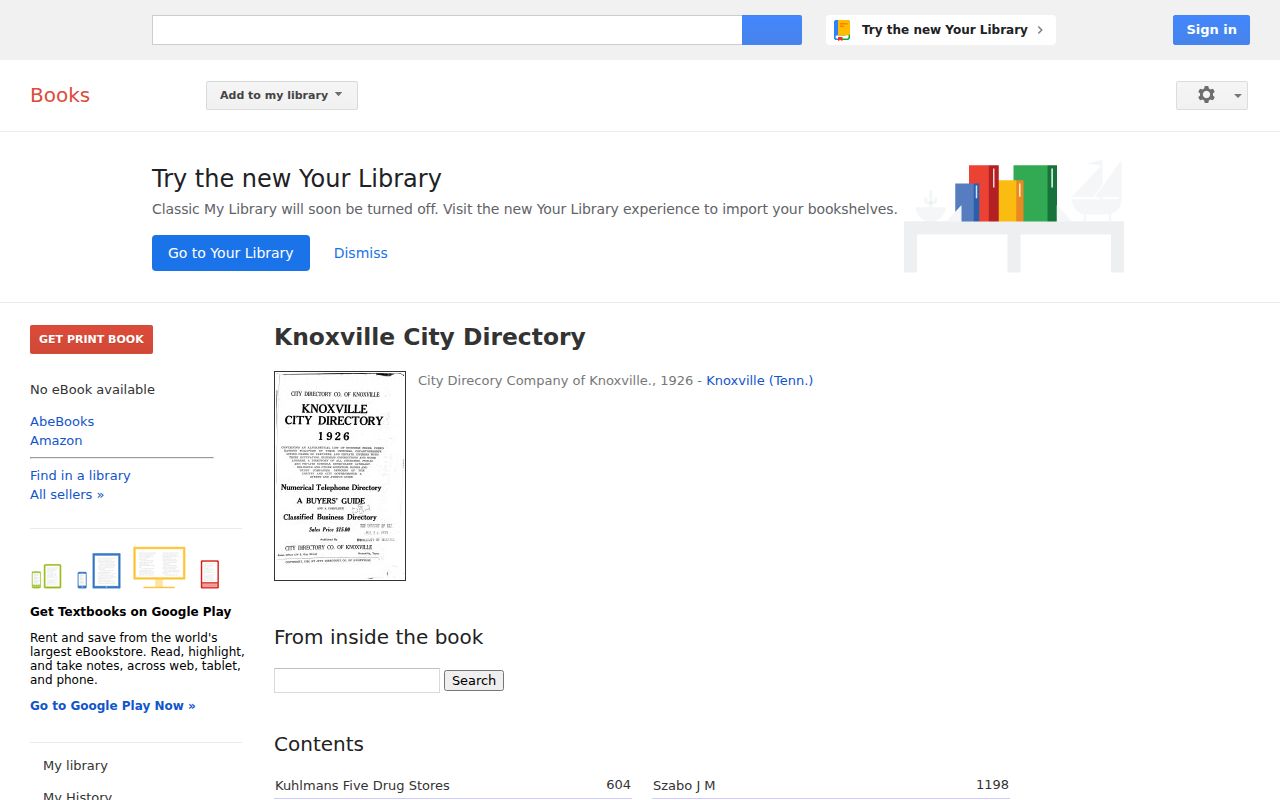
Use the volume as a historical finding aid, then corroborate a land or household conclusion with a deed, assessment record, census, obituary, probate file, or an original record from its custodian.
Farragut Directories and the 1953 Map
The Knox County Library’s Pre-Urban Renewal interactive map georeferences structure and occupant information extracted from a 1953 directory. It is a valuable model for reading an address together with a directory entry. Its focus is Knoxville, so it is not a complete Farragut resident list or a current source. Still, it demonstrates why an old street label, a structure, and a published occupant line need to be read together.
For a Farragut-area address, compare the map with KGIS historical aerial imagery, the directory’s place label, and the recorded parcel or deed description. Farragut’s incorporation date and changing postal geography mean that the modern town name may not appear in the older record. The local story is one of continuity through changing labels rather than a single municipal shelf.
Farragut Directory Companion Sources
Telephone books at McClung extend from 1898 onward and can be a useful second index, though a subscriber line does not prove every resident or even a personal line. The Knoxville Journal obituary index covers 1885–1906. A result may provide a surname, date, page, given name, age, or county and state of death. Copy requests are available by phone, mail, or email, with the library listing $3 for up to three obituaries from either database.
The Knox County Cross Index adds discovery routes for court, marriage, divorce, will, estate, naturalization, and delayed-birth series. Those indexes locate a lead; the actual record must come from the Archives or other custodian. Knox County Archives supplies permanent county land, tax, marriage, probate, court, and related records when a directory trail needs a document behind it.
The captured catalog record is the place to confirm a title and its documented holdings before making a trip or requesting assistance.
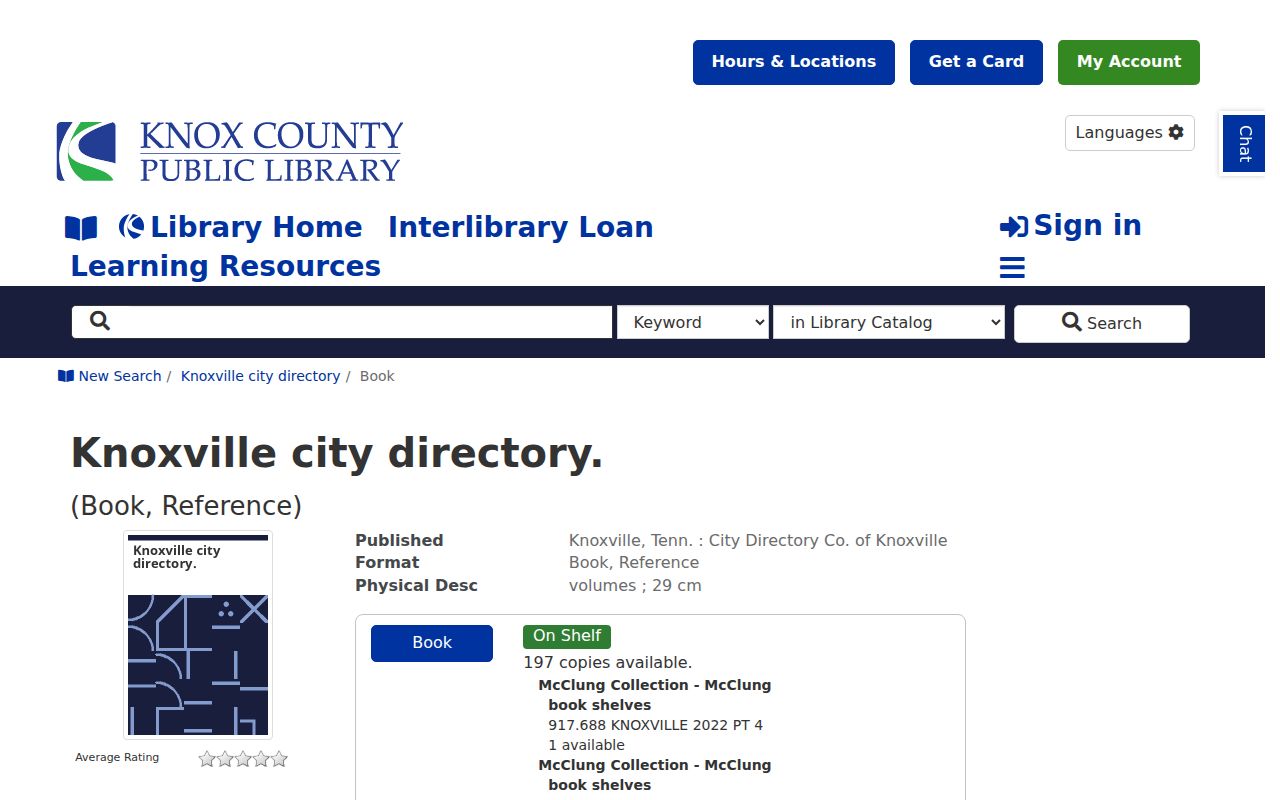
Catalog metadata identifies what is documented on the shelf; it does not turn a broad holding range into a claim that every intervening annual volume survives.
Tracing Families With Farragut Directories
Use a Farragut directory trail as a series of dated snapshots. The strongest method follows a name across nearby years, notes each street spelling and relationship mark, then tests changes against other records. Federal census records from 1790 through 1950 are generally accessible under the 72-year rule, but their county, ward, and enumeration labels may not match the incorporated Town.
- Find the first likely name entry and record the exact spelling, initials, address, spouse or widow notation, and page.
- Move one directory year backward and forward. Mark a move, a changed business line, or a shifted place label without assuming the reason.
- Search the street or criss-cross material where a verified volume offers it, then compare nearby listings and telephone books.
- Pair the directory year with the nearest available federal census and preserve the census geography as printed.
- Use deeds, an obituary, probate, or a marriage record to corroborate an endpoint or a relationship.
A disappearance can mean a move, death, omission, unlisted number, or changed editorial practice. It should never be treated as an answer by itself. The local historical shelf is valuable precisely because it makes those alternatives visible year by year.
Note: Preserve the original year and page with every directory transcription so later researchers can check the same printed context.
Farragut Directory Gaps and Archives
When a Farragut directory year is absent, shift to a record type that can test the missing interval instead of filling it with an assumption. Tennessee Probate Court Books cover 1795–1927 and include wills, bonds, inventories, settlements, sales, guardianships, administrations, claims, court minutes, and marriages. Tennessee Probate Court Files extend from 1795–1955. Probate can identify heirs, administrators, residences, relationships, and transfer dates that help explain a household change.
Marriage collections provide another bridge. The Tennessee County Marriages collection spans 1790–1959, while the Tennessee State Marriage Index spans 1780–2002. Catalog and image access can vary, and a free account may be needed to view an image. For a street or building question, the library’s Tennessee Sanborn access covers mapped communities from 1867–1970, but no Farragut-specific sheet was located. A map can show structures, materials, uses, and street names without identifying the people who lived there.
Knox County Archives is the practical fallback for permanent county series when neither an online volume nor the McClung shelf resolves the gap. Its land, tax, marriage, probate, court, and related materials can be requested or consulted through the access channels the Archives provides. Preserve the directory year, the archival series, and the reason for linking them in the research log.